
Occupied Healthcare Facility Renovation in Charlotte, NC
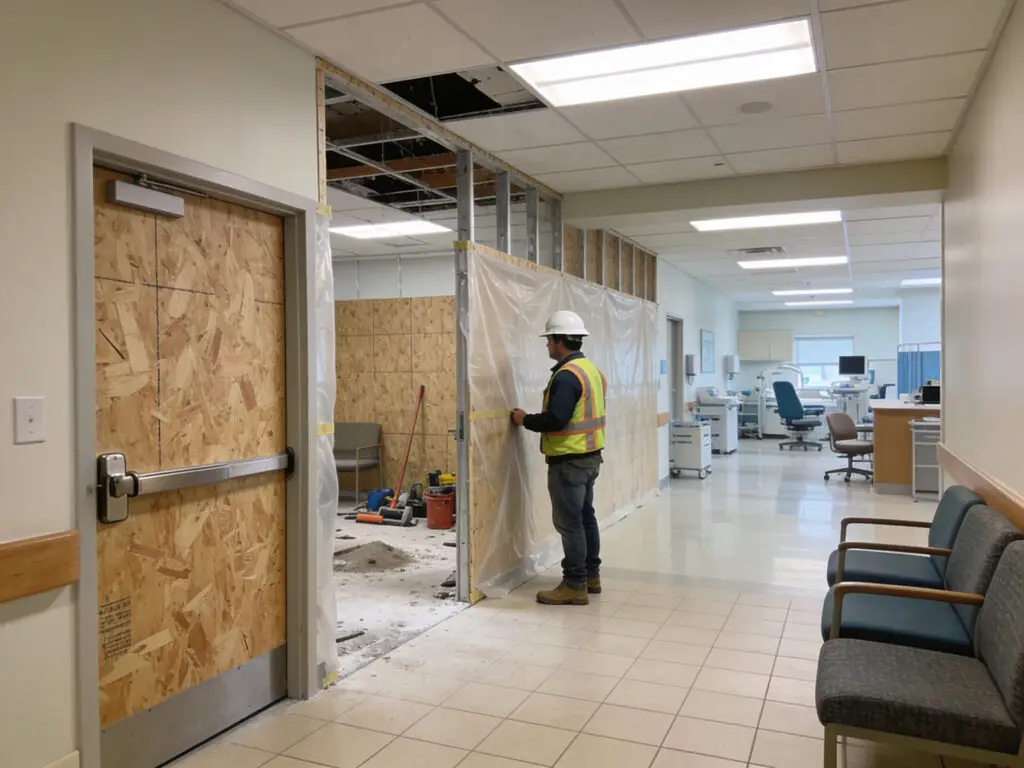
Renovating a healthcare facility is complex. Renovating one while physicians, nurses, employees, and patients continue using the building requires an entirely different level of planning and construction management.
Construction activities cannot be considered independently from healthcare operations. Dust, noise, vibration, temporary barriers, contractor access, utility shutdowns, patient circulation, life-safety systems, infection-control requirements, and daily clinical schedules can all affect how and when construction takes place.
Broad Reach Construction Management provides occupied healthcare facility renovation in Charlotte, NC, helping healthcare owners and facility teams manage construction while maintaining essential operations.
Our role is to coordinate the construction process around the people and services that still need to use the facility.
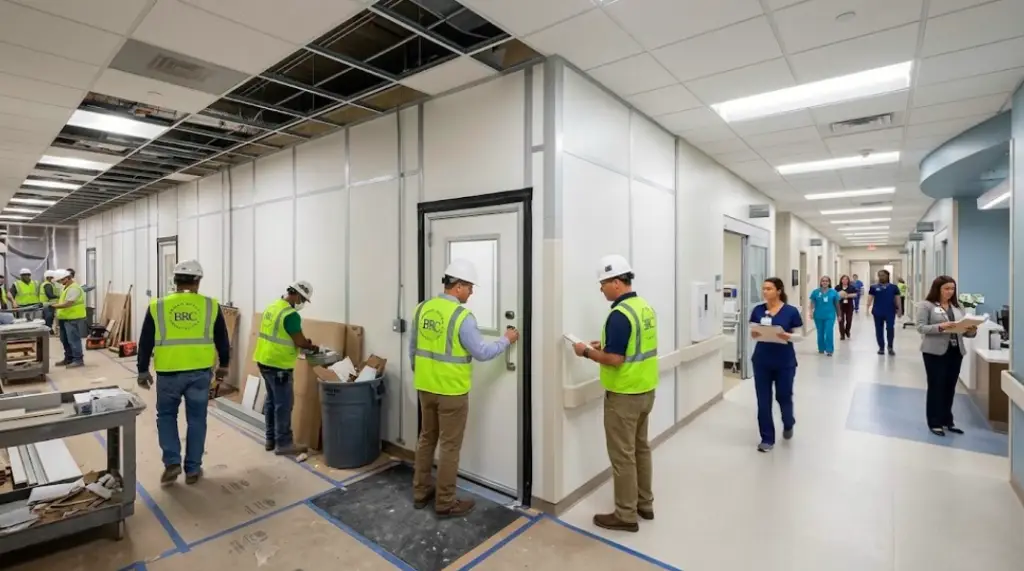
Renovating Healthcare Facilities While They Remain Operational
Many healthcare organizations cannot close an entire facility for renovation.
Patients still need access to care. Employees need safe working environments. Clinical departments must remain functional, and essential building systems may need to remain operational throughout construction.
This often requires the project to be divided into carefully planned phases.
One area may be taken out of service, isolated, renovated, inspected, cleaned, and returned to the healthcare organization before construction moves into another portion of the facility.
That process requires close coordination among:
- Healthcare facility leadership
- Clinical staff
- Construction management
- Architects and engineers
- General contractors
- Specialty trades
- Building engineers
- Infection-control personnel where applicable
- Equipment providers
- Inspectors and authorities having jurisdiction
Broad Reach manages these relationships as part of our Healthcare Construction Management services in Charlotte, NC.
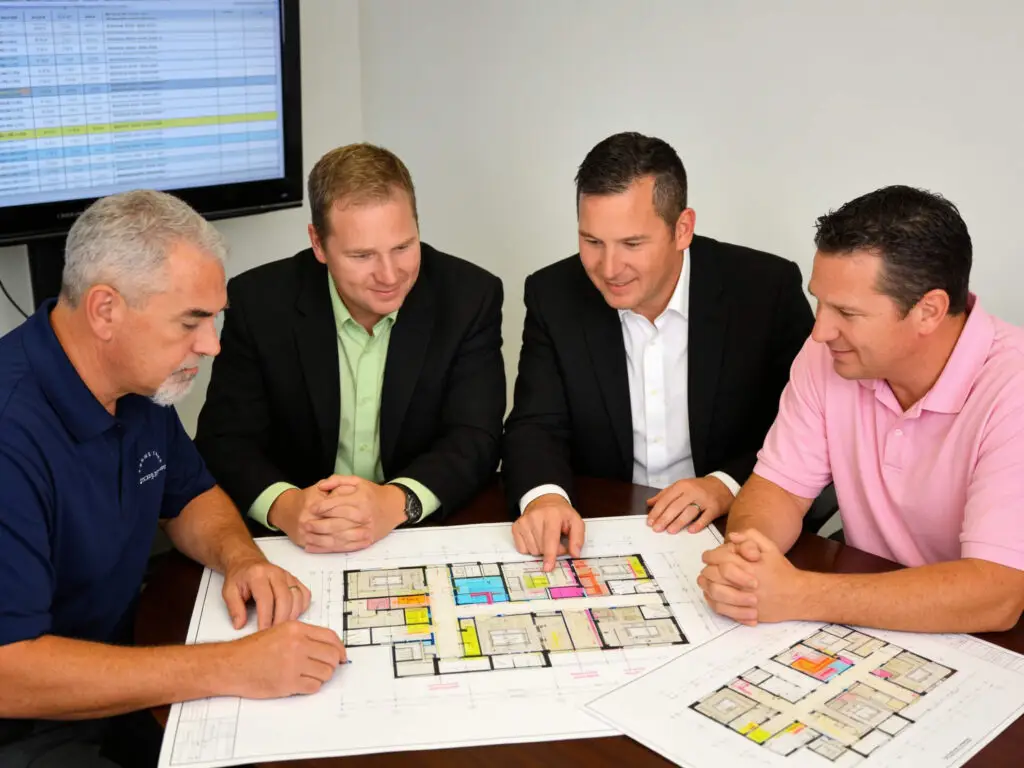
Pre-Construction Planning for an Occupied Healthcare Renovation
The most important decisions affecting an occupied renovation are often made before construction begins.
Broad Reach works with the project team to understand both the proposed construction and the healthcare operations surrounding it.
Planning may include:
- Existing-condition investigations
- Construction phasing
- Department sequencing
- Temporary barriers
- Patient and staff circulation
- Contractor access
- Material delivery routes
- Debris removal routes
- Work-hour restrictions
- Noise-producing activities
- Dust-control requirements
- Utility shutdowns
- Temporary services
- Life-safety considerations
- Inspection sequencing
- Equipment relocation
- Temporary clinical spaces
- Turnover requirements
Our Pre-Construction Planning Services in Charlotte, NC can help healthcare owners identify these constraints while the construction strategy can still be adjusted around them.
The objective is to anticipate how construction will interact with healthcare operations rather than trying to solve those conflicts after work begins
Phased Construction Around Healthcare Operations
Phasing is often the foundation of an occupied healthcare renovation.
Instead of turning the entire facility into a construction zone, the project can be divided into manageable areas.
A typical sequence may involve:
- Preparing the next construction zone
- Relocating affected operations
- Establishing barriers and controlled access
- Completing demolition and construction
- Performing required inspections
- Completing final cleaning and punch-list work
- Returning the renovated area to the healthcare organization
- Moving into the next phase
The exact strategy depends on the facility and scope, but the principle remains the same: construction sequencing must support healthcare operations.
A change to one phase can affect several others. Broad Reach monitors these dependencies so owners can understand the operational and schedule consequences of changes as the project progresses.
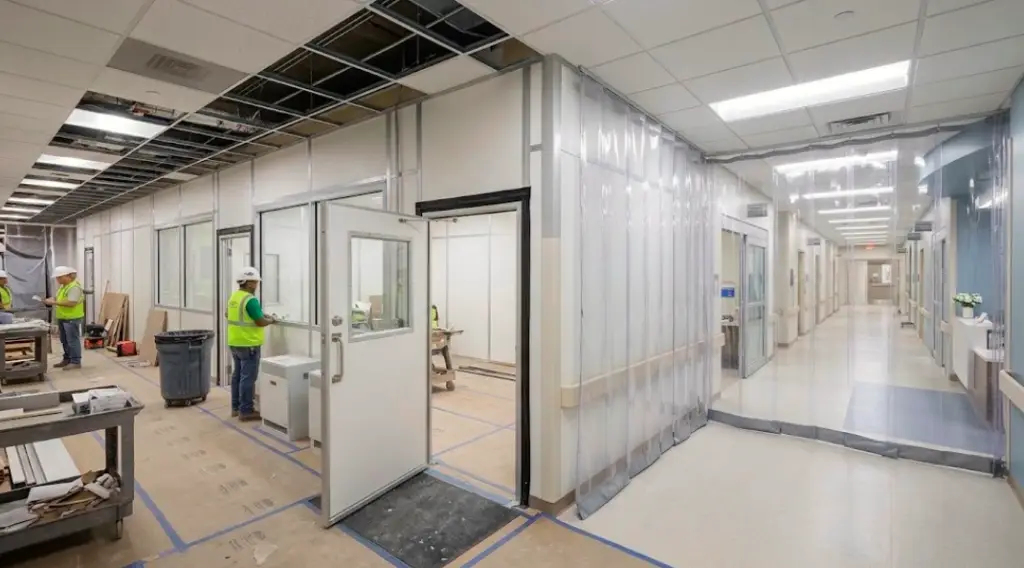
Construction Containment and Separation
Active construction needs to be appropriately separated from patient-care and operational areas.
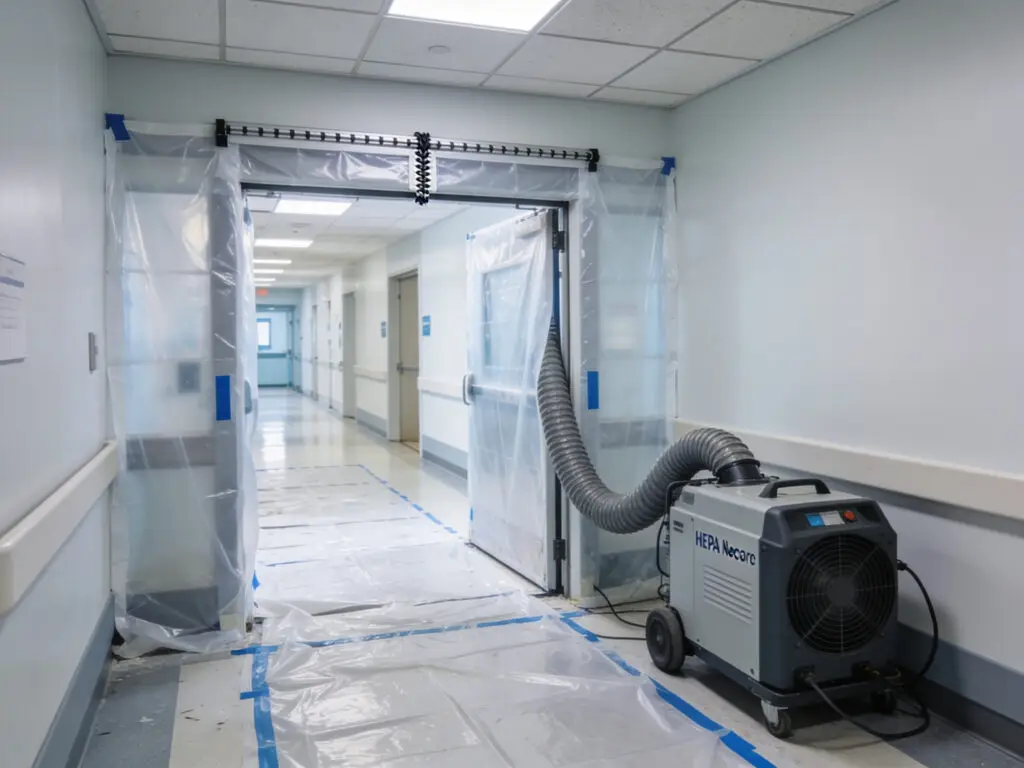
Depending on the project, temporary containment may be required to help control dust, debris, unauthorized access, and construction traffic.
Containment strategies can include:
- Temporary partitions
- Sealed construction barriers
- Controlled entrances
- Floor protection
- Dust-control measures
- HEPA filtration where appropriate
- Negative-air equipment where required
- Protected pathways
- Controlled debris removal
- Construction-zone signage and access control
The appropriate approach depends on the work being performed, the facility environment, applicable requirements, and the risk associated with surrounding operations.
Containment should be incorporated into the construction plan—not treated as an afterthought once demolition begins.
Infection-Control Considerations During Healthcare Construction
Construction can introduce dust, debris, airborne particles, water intrusion, and other conditions that require additional consideration in healthcare environments.
Depending on the facility and project, healthcare teams may establish infection-control procedures or assessments that affect how construction is performed.
Construction planning may need to address:
- Work-area isolation
- Dust containment
- Air-pressure relationships
- HEPA filtration
- Negative-air requirements
- Contractor access
- Debris transport
- Cleaning procedures
- Ceiling access
- Water-related construction activities
- Adjacent patient-care areas
Broad Reach coordinates construction activities with the facility’s established requirements and appropriate project professionals so these considerations can be incorporated into sequencing and field operations
Maintaining Patient and Staff Access
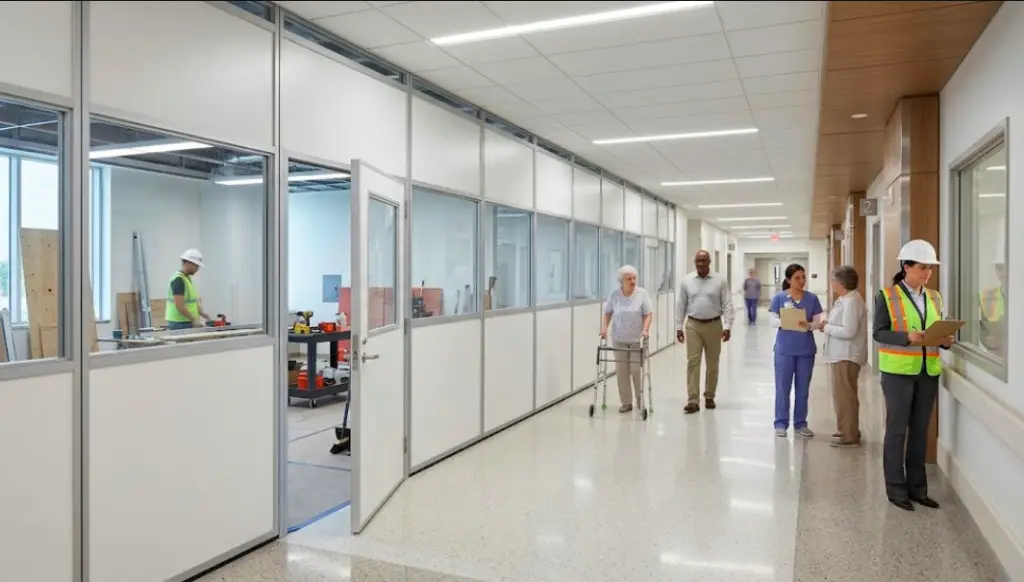
A healthcare facility can remain technically open while still becoming extremely difficult to navigate if construction circulation is poorly planned.
Patients may include elderly individuals, children, people with mobility limitations, and visitors unfamiliar with the building.
Staff may move repeatedly between departments during a shift.
Construction planning should therefore consider:
- Patient entrances
- Accessible routes
- Staff circulation
- Emergency routes
- Elevators
- Stairs
- Public corridors
- Temporary detours
- Department entrances
- Contractor circulation
- Material deliveries
- Debris removal
Where possible, construction traffic should be separated from patient and staff circulation.
Broad Reach works with facility representatives to establish logistics that support construction without unnecessarily interfering with daily healthcare operations.
Contractor Access, Deliveries, and Construction Logistics
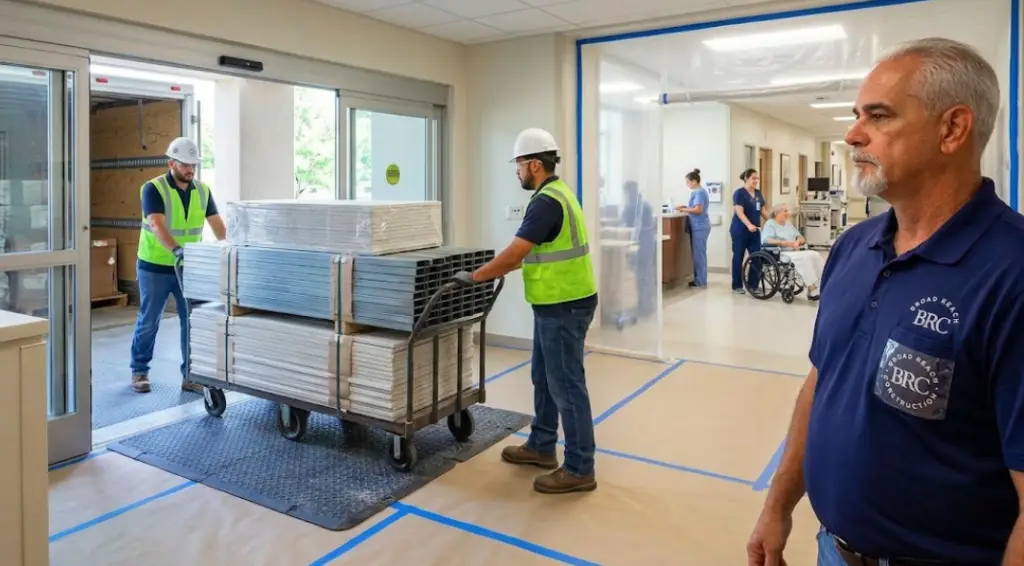
Occupied healthcare facilities often have limited tolerance for uncontrolled construction traffic.
Deliveries cannot simply arrive whenever convenient. Materials may need to move through specific entrances, elevators, corridors, or loading areas. Demolition debris may require controlled removal routes and restricted times.
Construction logistics may address:
- Contractor parking
- Worker entrances
- Delivery schedules
- Loading areas
- Elevator use
- Material staging
- Equipment movement
- Debris removal
- Temporary storage
- Work-zone access
- Security requirements
These details can seem minor during design, but poor logistics can become a daily source of disruption once construction begins.
Managing Noise and Vibration Around Patient Care
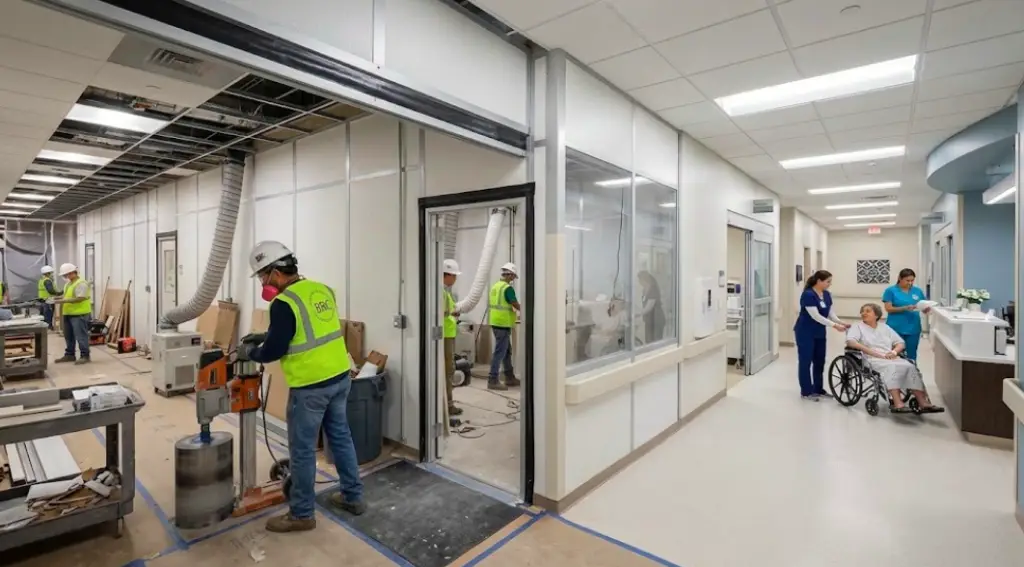
Demolition, drilling, cutting, coring, fastening, and other construction activities can generate significant noise and vibration.
Inside an occupied healthcare environment, the timing of these activities may matter as much as the work itself.
The project team may need to coordinate disruptive activities around:
- Patient-care schedules
- Procedures
- Diagnostic activities
- Staff operations
- Adjacent departments
- Facility quiet periods
- Building occupancy
Some work may need to occur during designated hours, evenings, weekends, or other approved periods.
Broad Reach incorporates these restrictions into construction sequencing so contractors understand when disruptive work can occur.
Planning Utility and Building-System Shutdowns
Healthcare facilities depend on mechanical, electrical, plumbing, fire protection, communications, technology, and other systems that may serve areas well beyond the immediate construction zone.
Renovation work may require these systems to be modified or temporarily interrupted.
Before a planned shutdown, the project team should understand:
- Which systems will be affected
- Which departments depend on them
- Whether adjacent areas will be impacted
- How long the interruption is expected to last
- Whether temporary service is needed
- What work must be completed during the shutdown
- How systems will be restored
- How restoration will be verified
Shutdown planning should involve appropriate facility representatives, engineers, contractors, and specialty trades.
Broad Reach coordinates these activities with the construction schedule so critical system work is planned rather than improvised in the field.
Life-Safety Planning During Construction
Renovation can temporarily alter corridors, exits, doors, fire protection systems, alarm devices, partitions, and other elements of a healthcare facility.
Those temporary conditions need to be considered throughout construction.
The project team may need to evaluate:
- Means of egress
- Temporary circulation
- Exit access
- Fire protection
- Fire alarm systems
- Temporary barriers
- Emergency access
- Construction-zone separation
- Inspection requirements
Life-safety considerations can also change as the project moves from one construction phase to another.
Broad Reach works with the appropriate design professionals, contractors, facility representatives, and authorities to coordinate construction sequencing with applicable life-safety requirements.
Existing Conditions in an Occupied Healthcare Facility
Existing conditions create another layer of uncertainty.
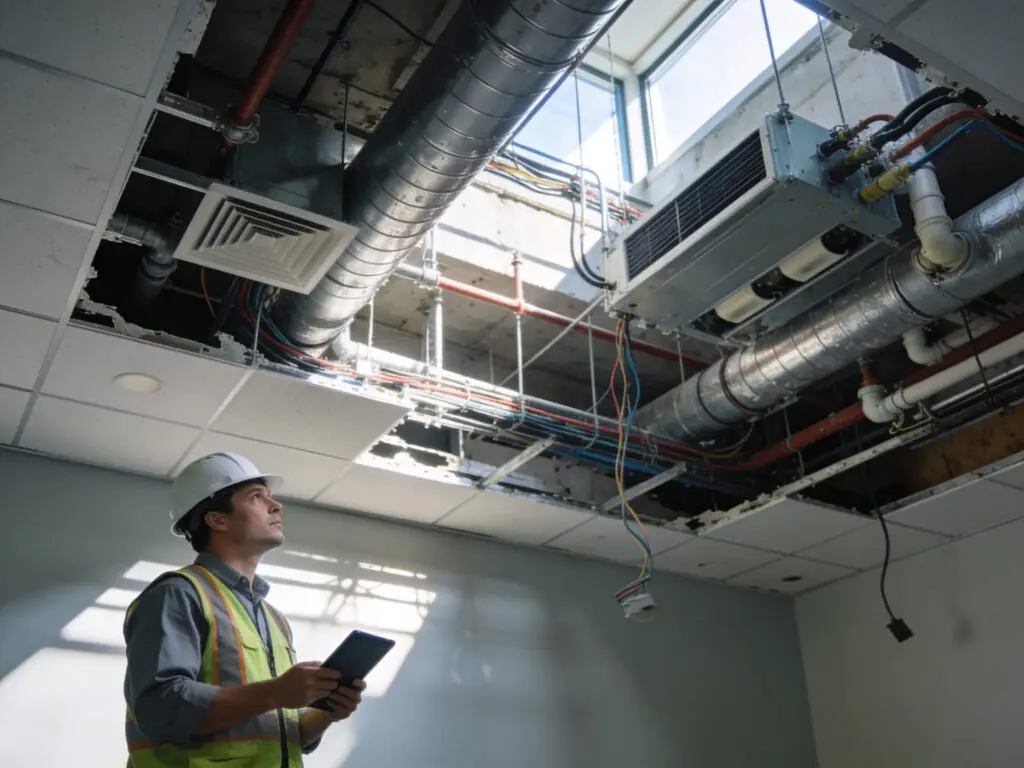
Healthcare facilities may have undergone multiple renovations and infrastructure modifications over many years. Existing drawings may not completely reflect conditions above ceilings, behind walls, or within mechanical and electrical systems.
Opening construction areas can reveal:
- Unexpected piping
- Undocumented electrical systems
- Congested ceiling spaces
- Structural conditions
- Abandoned utilities
- Existing equipment
- Different wall construction
- Building-system conflicts
These discoveries need to be evaluated quickly because a delayed decision can affect both the construction schedule and healthcare operations.
For broader facility modernization and infrastructure improvements, our Healthcare Facility Renovation in Charlotte, NC services address the planning and management of complex healthcare renovation projects.
MEP Coordination in Active Healthcare Environments
Mechanical, electrical, and plumbing work can be particularly challenging in an occupied healthcare facility because existing systems may continue serving active departments.
Construction teams may need to install new infrastructure while maintaining existing services until a planned transition can occur.
This can involve:
- HVAC modifications
- Electrical distribution
- Plumbing
- Fire protection
- Medical gas where applicable
- Building controls
- Low-voltage systems
- Security
- Communications
- Technology infrastructure
Sequencing these systems requires coordination among engineers, specialty contractors, facility personnel, and construction management.
The objective is to minimize unplanned interruptions while transitioning from existing conditions to the completed systems.
Daily Coordination With Healthcare Facility Teams
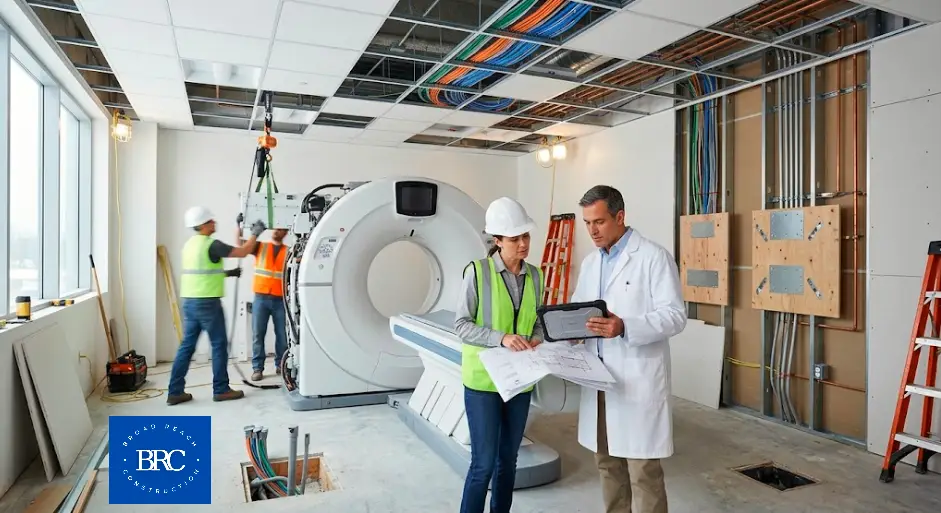
Occupied renovation requires more communication than an isolated construction project.
Conditions inside healthcare facilities can change.
Clinical schedules may shift. An area expected to be available may remain in use. A planned shutdown may need to move. A delivery route may temporarily become unavailable.
Broad Reach maintains communication with facility representatives and project stakeholders so these changes can be evaluated against the construction schedule.
Daily and weekly coordination may address:
- Upcoming construction activities
- Access requirements
- Deliveries
- Shutdowns
- Inspections
- Noise-producing work
- Department impacts
- Safety concerns
- Schedule changes
- Upcoming phase transitions
The goal is to give facility teams visibility into construction before activities affect their operations.
Turning Over Renovated Areas One Phase at a Time
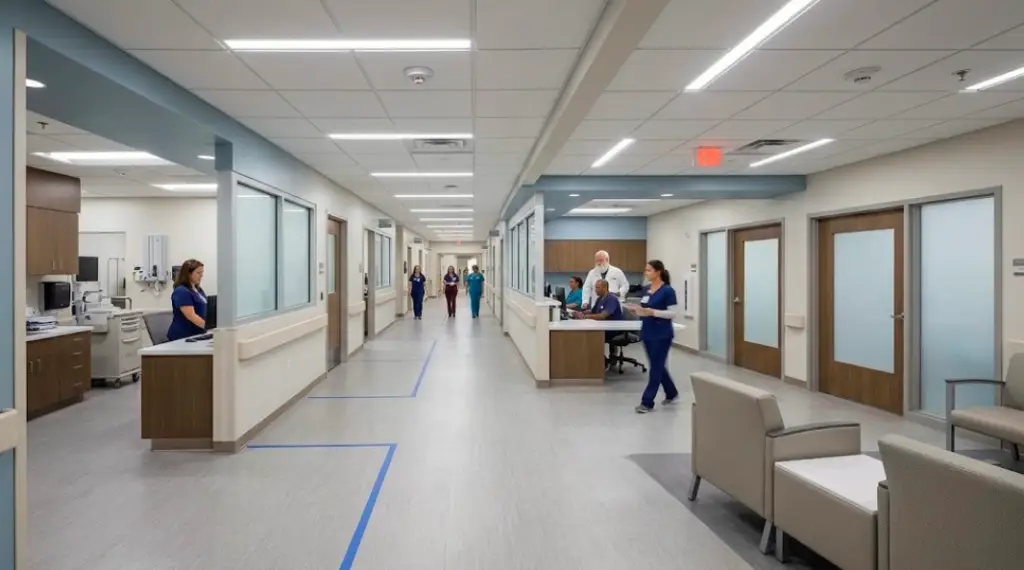
In phased healthcare construction, turnover is not limited to the end of the entire project.
Each completed area may need to pass through its own turnover process before the healthcare organization can reoccupy it.
That process can involve:
- Construction completion
- Punch-list work
- Inspections
- System testing
- Cleaning
- Equipment installation
- Technology installation
- Owner review
- Final corrections
- Department relocation
Only then can the next renovation phase begin.
Careful turnover planning helps prevent a delay in one completed area from creating a chain reaction across the remaining construction phases.
Occupied Healthcare Renovation Projects We Support
Broad Reach Construction Management can support occupied renovation projects involving:
- Outpatient healthcare facilities
- Medical office buildings
- Physician practices
- Specialty clinics
- Treatment facilities
- Diagnostic spaces
- Clinical departments
- Patient-care areas
- Healthcare tenant improvements
- Facility expansions
- Infrastructure upgrades
- Building-system modernization
- Administrative and support areas
For physician practices and smaller outpatient settings, our Medical Office Renovation services in Charlotte, NC focus specifically on renovating and reconfiguring existing medical offices.
For new clinical spaces created within commercial buildings, learn more about our Medical Office Build-Outs services in Charlotte, NC.
Healthcare Construction Planning Resources
Occupied healthcare construction requires owners and facility teams to consider operational issues well before demolition or construction begins.
Broad Reach Construction Management developed a Healthcare Construction Management Guide to help owners, developers, architects, and facility professionals understand planning, scheduling, building systems, safety, phasing, and other considerations affecting healthcare construction.
[Visit the Broad Reach Construction Resource Library and access the Healthcare Construction Management Guide →]
The guide is available as a complimentary resource for organizations planning healthcare renovations, expansions, build-outs, and new construction.
Part of Broad Reach's Charlotte Healthcare Construction Services
Occupied facility renovation is one component of Broad Reach’s broader Healthcare Construction Management in Charlotte, NC capabilities.
Our healthcare experience is supported by our Commercial Construction Management in Charlotte, NC services, providing owners with structured pre-construction planning, scheduling, cost management, procurement, trade coordination, field oversight, and owner representation.
This construction management approach is particularly valuable in occupied healthcare environments where the consequences of poor coordination can extend beyond the construction zone.







Why Choose Broad Reach for Occupied Healthcare Renovation?
Occupied healthcare renovation requires more than managing contractors.
The construction team must understand how each activity can affect the facility surrounding the work.
Broad Reach provides:
- Healthcare construction experience
- Pre-construction planning
- Phased construction management
- Construction containment coordination
- Existing-condition evaluation
- MEP and specialty-trade coordination
- Shutdown planning
- Construction logistics
- Schedule management
- Cost control
- Permitting and inspection coordination
- Quality and safety oversight
- Hands-on field supervision
- Clear communication with facility teams
Our role is to create structure around a complicated construction environment so owners, facility teams, contractors, and design professionals remain coordinated throughout the project.
Posted on Google
 Jim Pevarnik24 days ago
Trustindex verifies that the original source of the review is Google.
Our company, Pevarnik Bros., Inc., has done numerous projects with Broad Reach Construction since 2024. I can unequivocally say that Broad Reach, and Kevin Morgan in particular, is the most ethical and fair General Contractor that I've worked with in my 20 years of being a subcontractor. Not only that, but they also look at the big picture and don't sacrifice quality for schedule and/or money. I make these statements with a lot of knowledge of the construction industry, and we've worked with some of their competitors as well, and Broad Reach is tops. They've earned it through hard conversations on tight project timelines. Kevin doesn't waste energy looking for someone to blame when things don't go as planned, he laser focuses on solutions. It's amazing how well projects go when you have a General Contractor that is solution focused and doesn't look down on his subcontractors.Posted on Google Michael Morgan173 days agoI had the opportunity to work with Broad Reach On a EV charging Project in Charlotte, North Carolina. I was impressed with their attention to detail and making sure the project keeps moving forward.Posted on Google
 Susan Lynch175 days agoI had the pleasure of working with Broad Reach Construction on a large-scale commercial project in Charleston, SC, and the experience exceeded every expectation. From start to finish, their team demonstrated a level of professionalism, organization, and craftsmanship that truly sets them apart in the industry. Broad Reach Construction consistently maintained high standards across the board from project management and scheduling to execution and final delivery. The team was collaborative, responsive, and solution-oriented. It is rare to find a construction partner that combines technical expertise with such a strong commitment to client satisfaction. I would highly recommend Broad Reach Construction to anyone looking for a reliable, skilled, and trustworthy team for commercial projects. I look forward to the opportunity to work with them again in the future. Susie Lynch Stone InteriorsPosted on Google
 Peter Dombroski366 days agoHas been a good experience working with Broad Reach on multiple projects.Posted on Google
 Ashley Bryant368 days agoGreat team to work with. Fantastic attention to every detail. Completely satisfiedPosted on Google
 Janell Solinski387 days agoBroad Reach Construction is a company that truly puts people first. They not only take care of their clients but also value their employees, which really shows in the way the team works together. Kevin Morgan leads with honesty and integrity, and the quality of their work is always impressive.

Planning an Occupied Healthcare Renovation in Charlotte?
If your healthcare facility needs to be renovated, expanded, or modernized while remaining operational, the construction strategy should be developed around facility operations from the beginning.
Broad Reach Construction Management helps healthcare owners and facility teams plan construction phasing, logistics, building-system work, shutdowns, schedules, and field activities while maintaining focus on the healthcare environment surrounding the project.
Call Broad Reach Construction Management at 984-332-3927 to schedule a consultation.
Occupied Healthcare Facility Renovation FAQs
Can a healthcare facility remain open during renovation?
In many cases, portions of a healthcare facility can remain operational while construction occurs in controlled areas. Whether this is practical depends on the facility, scope, building systems, patient-care requirements, safety considerations, and ability to phase and separate the work appropriately.
How is construction separated from patients and staff?
Depending on the project, separation may include temporary partitions, sealed barriers, controlled access points, floor protection, designated contractor routes, dust-control measures, and other methods appropriate to the facility and construction activity.
How do you control dust during an occupied healthcare renovation?
Dust-control measures depend on the work and healthcare environment. Strategies may include construction containment, sealed barriers, controlled access, HEPA filtration, negative-air equipment where required, housekeeping procedures, and controlled debris-removal routes.
Can noisy construction work be performed while the healthcare facility is open?
It may be possible, but disruptive activities often need to be coordinated with facility operations. Drilling, demolition, coring, and other noisy work may be restricted to certain hours or scheduled around patient-care activities.
How are utility shutdowns managed in an occupied healthcare facility?
Shutdowns should be planned with facility representatives, engineers, contractors, and appropriate specialty trades. The team identifies affected systems and departments, determines the expected duration, evaluates temporary-service needs, coordinates the work window, and plans restoration.
Why is phasing important during healthcare renovation?
Phasing allows construction to progress in controlled areas while other portions of the healthcare facility remain operational. Each phase can be isolated, completed, inspected, cleaned, and returned to service before work moves into another area.
When should planning begin for an occupied healthcare renovation?
Planning should begin as early as practical. Early construction involvement provides more opportunity to evaluate existing conditions, phasing, containment, logistics, shutdowns, building systems, schedule, budget, permitting, and the potential impact of construction on healthcare operations.